The EU AI Act Article 12 Deadline Just Moved. Here Is What Still Has a 2026 Deadline.
The EU Council and Parliament agreed on May 7 to push the high-risk AI compliance deadline from August 2026 to December 2027. Multiple parallel mandates — DORA, NIS2, GPAI obligations, transparency rules — did not move. Here is what the Omnibus VII delay actually changes for organizations deploying AI agents.

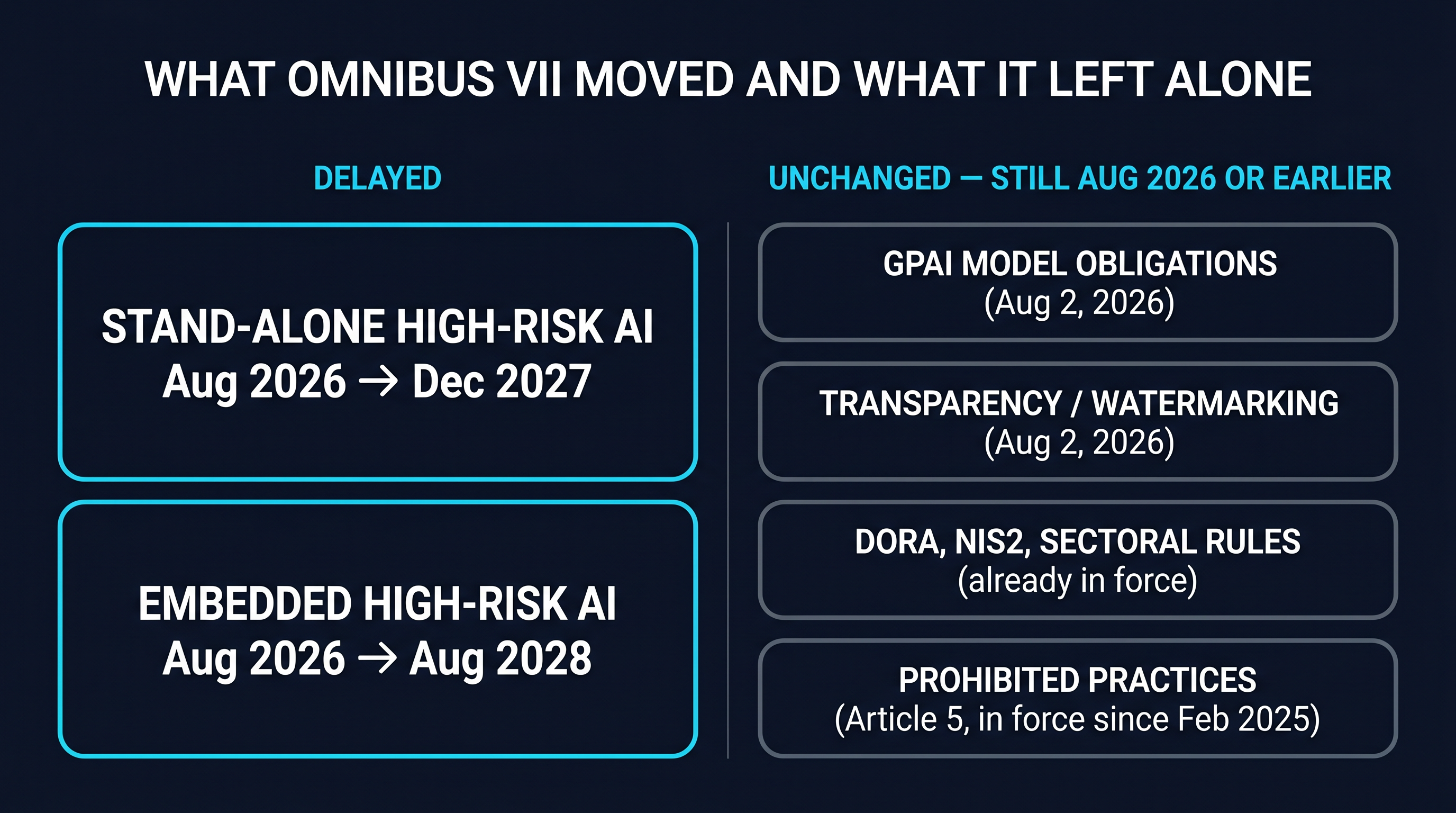
On May 7, 2026, the Council of the European Union and the European Parliament reached a provisional agreement on what is being called the AI Omnibus VII package. The headline change is the one that travels: the high-risk AI compliance deadline that was set for August 2, 2026 has been pushed back. Stand-alone high-risk AI systems now have until December 2, 2027 to comply with the European AI Act’s Article 12 logging requirements and the rest of the high-risk obligations. Embedded high-risk AI systems have until August 2, 2028.
For organizations that have been pacing their compliance work against an August 2026 wall, this is a sixteen-month reprieve on paper. The full story is more nuanced, and the practical implications for AI agent infrastructure depend on which deadlines an organization was actually anchoring against. Several adjacent mandates did not move. Article 12’s substance did not change. The classification of “high-risk AI” did not change. And the agreement itself is provisional — it has not yet been formally adopted, which means the original August 2026 deadline remains technically in force until the final vote.
This is the kind of regulatory event that benefits from being read carefully rather than summarized. The reading below maps what changed, what did not, and what an enterprise’s compliance roadmap should now look like for the second half of 2026.
What Omnibus VII Changes
The Omnibus VII agreement is a coordinated effort by the Council and Parliament to simplify and streamline the AI Act’s implementation timeline. The Council’s press release on May 7 framed it as a response to feedback from regulated parties that the original timeline was too compressed for the regulatory infrastructure — the AI Office, the technical standards bodies, the national supervisory authorities — to deliver in time. The delay applies specifically to the high-risk AI obligations defined in Title III of the AI Act, which include the conformity assessment requirements, the risk management system requirements, the human oversight provisions, and the Article 12 automatic event logging mandate.
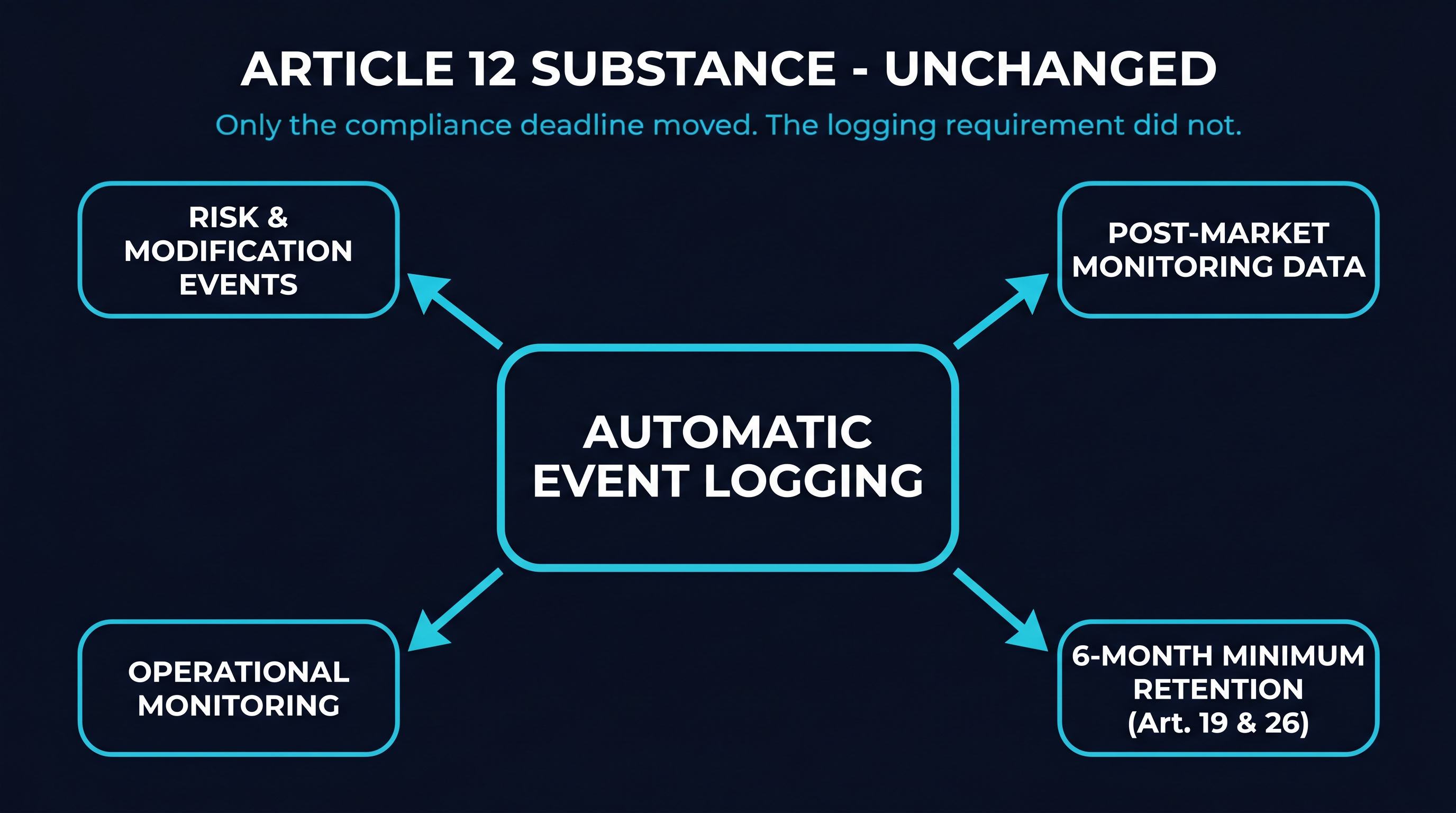
For Article 12 in particular, the change is straightforward. Article 12 requires high-risk AI systems to maintain automatic, lifetime event logs covering three categories of events: risk and modification events, post-market monitoring data, and operational monitoring. The retention period (six months minimum, defined across Articles 19 and 26), the technical interpretation framework (Article 13), and the substantive logging requirements all remain the text of the regulation. What changed is when high-risk AI systems must be in compliance with that text.
The delay creates two different deadlines depending on the deployment shape:
| System Type | Old Deadline | New Deadline |
|---|---|---|
| Stand-alone high-risk AI | August 2, 2026 | December 2, 2027 |
| Embedded high-risk AI | August 2, 2026 | August 2, 2028 |
A stand-alone high-risk AI system is a system whose primary function is the high-risk task — for example, a recruitment screening system or a credit scoring system that is the system, not a feature inside a broader product. An embedded high-risk AI system is a system where the high-risk function is one capability within a larger product, such as an AI-driven biometric verification feature inside a consumer banking application. The Council’s text treats the two cases differently because the integration burden differs.
The political process is also worth naming. Omnibus VII is the seventh omnibus package the Council has used to bundle adjustments to existing EU regulations into a single coordinated vehicle. It has been agreed in principle by the negotiating teams but not yet formally voted by both bodies. Until the formal vote, the original August 2026 deadline is the legally binding one. Practical compliance planning will treat the new deadline as the operative one, but procurement and audit conversations that rely on the legal force of the deadline should not yet treat December 2027 as final.
What Omnibus VII Does Not Change
The more important section, for most practical compliance work, is the list of obligations that did not move with the high-risk timeline.
General-purpose AI (GPAI) model obligations remain at August 2, 2026. Title VIII of the AI Act regulates providers of GPAI models — the foundation model providers, the API vendors, and any organization that puts a general-purpose AI model on the EU market. Their obligations include technical documentation, instructions for downstream deployers, copyright compliance, and transparency about training data. The Omnibus VII agreement explicitly preserved this deadline. Organizations that consume or fine-tune GPAI models from European providers will see those providers’ compliance work proceeding on the original timeline.
Transparency obligations remain at August 2, 2026. Article 50 of the AI Act governs the transparency provisions — synthetic content disclosure, AI-generated content watermarking, the requirement that humans be informed when they are interacting with an AI system. None of these obligations moved. For consumer-facing AI products, the transparency layer has to be in place by August 2026 regardless of whether the underlying system is also classified as high-risk.
Sectoral regulations remain on their own timelines. This is the part that gets missed in headline coverage. The EU AI Act is one of several parallel regulatory frameworks that govern how AI systems can be deployed in regulated industries. The Digital Operational Resilience Act (DORA), which has applied to financial entities since January 17, 2025, includes ICT risk management requirements that incidentally cover AI-driven systems used by banks, insurers, and investment firms. DORA was not affected by Omnibus VII. The Network and Information Security Directive 2 (NIS2), which applies to operators of essential services across multiple sectors, was not affected. The Medical Device Regulation (MDR) requirements for AI-based medical devices were not affected.
For financial services, healthcare, energy, transport, and the other regulated sectors, the AI deployments that would have been governed by Article 12 from August 2026 forward are typically also governed by one of these sectoral regimes. The sectoral regime’s logging, audit, and risk management requirements have not been deferred. The compliance position of an EU bank, an EU hospital network, or an EU utility operator is therefore not “AI compliance pushed to 2027” — it is “AI Act compliance pushed to 2027, but DORA, NIS2, or the sectoral equivalent still applies for 2026.”
Prohibited AI practices (Article 5) are already in force. The hard prohibitions on certain AI practices — social scoring by public authorities, real-time remote biometric identification in public spaces with narrow exceptions, manipulation through subliminal techniques — took effect February 2, 2025. These have been law for fifteen months. No part of Omnibus VII touches them.
The classification of “high-risk AI” did not change. Annex III of the AI Act lists the categories of systems classified as high-risk: biometric identification, critical infrastructure, education and vocational training, employment and worker management, essential private and public services (including credit scoring), law enforcement, migration and border control, administration of justice and democratic processes. The list is the same after Omnibus VII as before. Any deployment that meets the criteria for high-risk classification is still high-risk; only the deadline for that classification to trigger compliance obligations has moved.
What Compliance Roadmaps Should Look Like Now
The practical reading for organizations that were anchoring their AI compliance work against August 2026 has three layers.
The first layer is the sectoral one. Organizations in financial services, healthcare, critical infrastructure, telecommunications, energy, and the other DORA/NIS2/sectoral-regulated industries should treat their AI compliance roadmap as functionally unchanged. The sectoral regulators have not deferred their requirements, and the logging, audit, and risk management infrastructure required by those regulators is substantially the same infrastructure that Article 12 would have required. An organization that built its AI agent infrastructure to satisfy Article 12 by August 2026 has built infrastructure that also satisfies DORA’s ICT risk management requirements, NIS2’s incident reporting obligations, and the sectoral audit requirements. The infrastructure investment is not stranded; the regulatory anchor has just shifted from the AI Act to the parallel sectoral framework.
The second layer is the GPAI and transparency one. Organizations that provide or deploy general-purpose AI models in the EU, and organizations whose AI products interact directly with consumers, retain an August 2026 deadline for the transparency and GPAI obligations. The compliance work required for these obligations is not the same as the work required for Article 12 — it focuses on disclosure, watermarking, and documentation rather than on event logging — but it is on the same timeline that was assumed three months ago.
The third layer is the strict high-risk one. Organizations whose AI deployments are classified as high-risk under Annex III but are not also covered by a sectoral regime now have a longer runway. The classic example is a private-sector employer using AI in hiring decisions: the system is high-risk under Annex III, but the employer is not regulated under DORA or NIS2. For this kind of deployment, the December 2027 deadline does represent a real sixteen-month extension on the operative compliance pressure. The original infrastructure investments are still required — they have not been canceled, only deferred — but the project plan can accommodate the longer timeline.
The mistake to avoid, across all three layers, is reading Omnibus VII as a pause on AI compliance work generally. Two-thirds of the obligations that organizations were planning toward have not moved. The third that did move was the one most heavily covered in trade press because August 2 was a vivid date and December 2 of the following year is not. The practical effect on a regulated organization’s compliance work is usually small. The practical effect on AI infrastructure design choices is essentially zero.
What This Means for AI Agent Infrastructure
The architectural decisions that organizations were making for Article 12 — admission control at the agent-tool boundary, per-invocation audit logging, lifetime retention of agent activity records — are the same decisions that satisfy DORA’s ICT risk management requirements, NIS2’s logging obligations, the sectoral audit frameworks, and (for the Annex III deployments that are not also sectorally regulated) the eventual December 2027 high-risk obligations.
This convergence is not a coincidence. The regulatory frameworks are independently arriving at the same operational requirements because the underlying risks are the same. Whether the regulator is the European Insurance and Occupational Pensions Authority pursuing DORA enforcement, the European Banking Authority pursuing operational resilience, or the EU AI Office pursuing eventual Article 12 enforcement, the question they will ask of a regulated entity is structurally the same: can you tell us, for any specific moment in the past, what AI agents made what decisions using what tools on what data, and can you produce that record on demand?
The infrastructure that answers this question is the same infrastructure across all regulators. The deadline that compels the answer is what Omnibus VII rearranged. The substance did not move.
The Provisional Status Matters
A final practical note. Omnibus VII is provisional. The agreement reflects a deal between the Council’s and Parliament’s negotiators, but it has not yet been formally adopted by either body. Until the formal vote — which is expected later in 2026 but not yet scheduled — the original August 2, 2026 deadline remains the legally binding one for stand-alone high-risk AI systems.
In practice, this matters less for compliance planning than it might seem. No EU regulator is going to enforce a deadline against an organization that is acting in good faith toward the new agreed deadline. But for procurement, audit, and legal review processes, the conservative position is that the formal text of the AI Act has not yet changed. Vendor questionnaires that reference “August 2026 readiness” remain technically accurate. RFP responses that commit to August 2026 compliance are not invalidated by the agreement. Internal legal teams that treat the new deadline as operative are taking a reasonable bet, but it is a bet rather than a certainty until the formal adoption.
The probability that Omnibus VII does not get adopted is low. Both the Council and the Parliament have political reasons to land the package, and the negotiation has already done the hardest work. But “low probability of reversal” is not the same as “deadline is now December 2027.” The accurate framing for the next several months is: the deadline is August 2026 by current law, December 2027 by political agreement, and the practical compliance posture should be calibrated to the December 2027 timeline while preserving the option to defend an August 2026 posture if it becomes necessary.
The Steady Direction Underneath the Schedule
Underneath the schedule debate, the direction of the EU’s AI regulation has been remarkably steady. The substantive obligations — automatic event logging, risk management systems, human oversight, technical documentation, transparency — have been the same since the AI Act’s text was finalized in 2024. The classifications of high-risk and prohibited AI have been the same. The penalty framework has been the same. The political adjustments that have happened, of which Omnibus VII is the most recent, have all been to the timing of implementation, not to the obligations themselves.
This is the part of the regulation that an AI infrastructure decision should be calibrated against. The obligations are durable. The deadlines move. The infrastructure required to satisfy the obligations does not change when the deadlines do. An organization that built its AI agent stack to satisfy Article 12 substance, DORA’s ICT risk requirements, NIS2 logging, and the sectoral parallels has built the right stack regardless of whether the AI Act deadline lands in 2026, 2027, or some later schedule. The schedule will keep moving. The substance keeps describing the same operational shape.
For the second half of 2026, the practical answer is: build for the substance, not the date.